



When did you last clean your dishwasher? If you don’t even remember, this is the perfect time to learn how important it is.
Every cycle exposes the dishwasher to food residue, grease, detergent, and minerals from the water supply. Some of the residue can collect around the filter, spray arms, door seals, and bottom of the tub. Eventually, the buildup may cause unpleasant odors, leave food particles on dishes, or cloud glassware.
Some people may assume their dishwasher is hard to clean. Fortunately, it’s not. Cleaning a dishwasher doesn’t require taking it apart. Most hands-on work takes less than an hour, although the final cleaning cycle may take longer.
Before you start cleaning your dishwasher, find the manual. If the paper manual is missing, look for the model number on a label along the door or tub opening, then use it to find the manual online.
What to Prepare
Here is everything you need before cleaning your dishwasher. You may already have this stuff in your kitchen:
- Warm water
- Protective gloves
- A small amount of dish soap
- A soft microfiber cloth or nonabrasive sponge
- A soft brush, such as an old toothbrush
- A dishwasher cleaner approved for your model, if needed
Once the supplies are ready, empty the dishwasher and make sure the appliance has finished its last cycle. Allow the interior and heating element to cool before reaching into the tub.
Please note that dish soap should only be used for hand-cleaning removable parts and surfaces. Never pour regular dish soap into the detergent dispenser or add it to a dishwasher cycle because it can create excessive suds and leaks.
Step 1: Empty the Dishwasher, Remove Loose Debris
Take out all dishes and pull the lower rack forward. If the rack lifts out easily and the manual allows its removal, take it out for better access to the bottom of the dishwasher.
Inspect the tub floor, corners, and area around the filter or drain. You may find food scraps, labels from jars or fruit, small bones, seeds, or even pieces of broken dishes.
Remove food and other loose debris with a paper towel. If you find broken glass or another sharp object, wear protective gloves and use tongs to pick it up carefully. Never use bare hands or push debris toward the drain.
Step 2: Remove and Clean the Dishwasher Filter
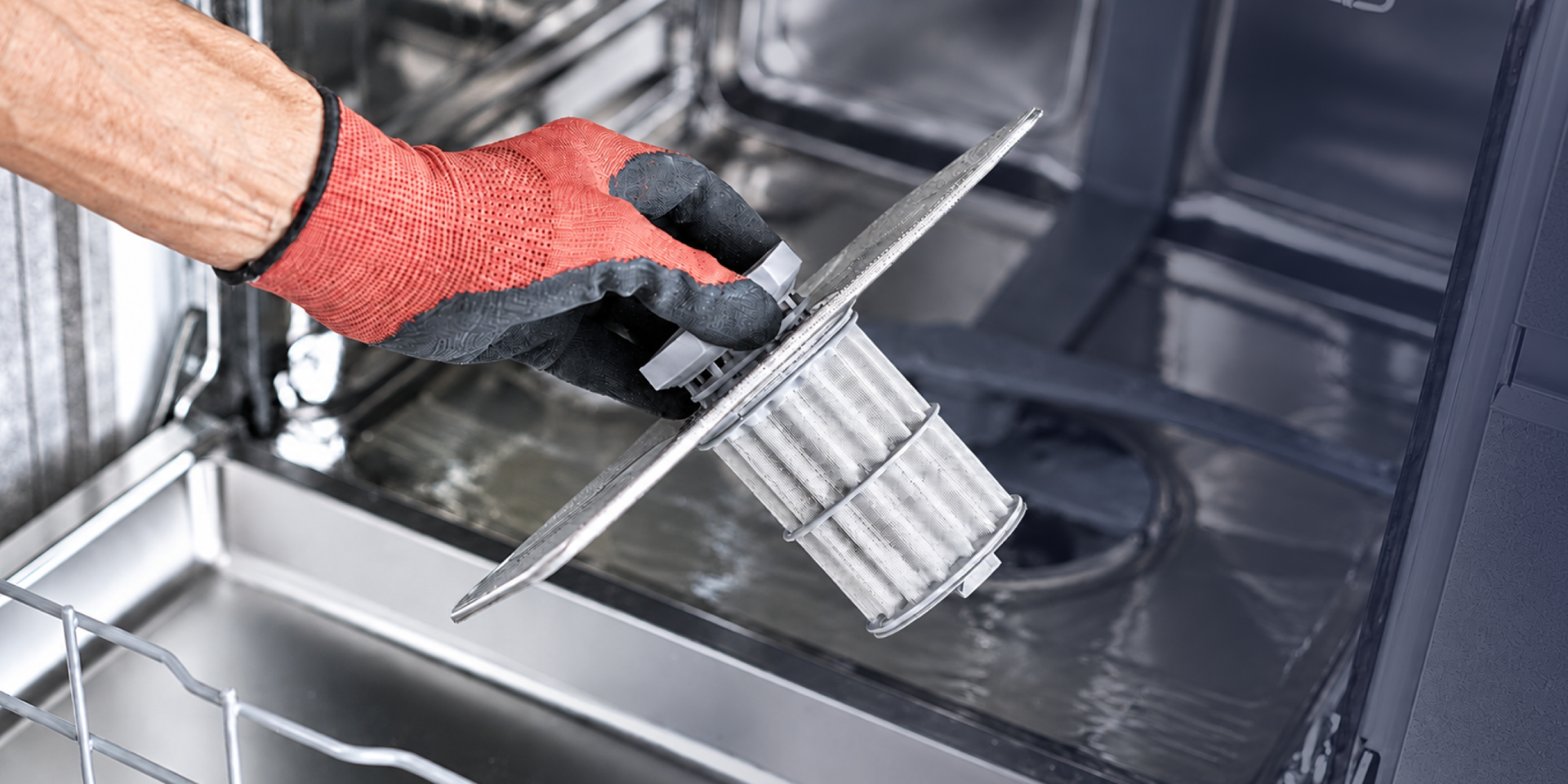
A dirty filter can cause odors, leave gritty residue on dishes, and reduce cleaning performance. However, not every dishwasher has a removable filter, so check the owner’s manual before attempting to remove one.
Here is the easy way to clean most removable filters:
- Remove the lower rack and locate the filter near the lower spray arm or in a rear corner of the tub.
- Turn the cylindrical filter counterclockwise and lift it out.
- Remove the flat lower filter if your model has one.
- Rinse each piece under warm running water.
- Use a soft brush and a small amount of dish soap for stubborn grease or mineral deposits.
- Avoid wire brushes, scouring pads, and abrasive cleaners because they can damage the filter mesh.
- Reinstall each piece and turn the upper filter until it locks securely.
- Never run the dishwasher with the filter missing or incorrectly installed.
- Check the filter about once a month and clean it whenever you find visible residue.
Heavily used dishwashers may need more frequent filter cleaning, so follow the schedule in the owner’s manual when available.
Step 3: Inspect and Clean the Spray Arms
The spray arms are the rotating parts that distribute water throughout the dishwasher. Each arm contains small openings that direct water toward the racks. A clogged spray arm may reduce cleaning performance or cause one rack to clean better than another.
Here’s what you need to do to clean the spray arms
- Gently spin each spray arm by hand to make sure it moves freely.
- Check that tall dishes, utensils, or loose rack components are not blocking its path.
- Inspect the spray openings for visible debris.
- Use a soft brush or another tool recommended in the owner’s manual to loosen the blockage without pushing it farther into the arm.
- Clean the arms in place unless the manual provides removal instructions. Some dishwasher models let you unclip or unscrew the spray arms and rinse them at the sink. Other models do not have user-removable spray arms.
Step 4: Wipe the Door, Seals, and Interior
Several areas around the dishwasher door receive less direct spray during a cycle. Grease, food residue, and detergent can gradually collect on these surfaces.
Use a damp cloth with warm soapy water to clean these parts:
- The rubber gasket around the door, including its folds
- The bottom lip of the door and the hinge area
- The detergent dispenser and its flap
- The edges of the door panel outside the main tub
- Visible residue on the tub walls and floor
Use the soft brush to reach narrow folds and corners. Wipe the surfaces again with a clean, damp cloth to remove any remaining soap, then dry the door seal.
Avoid scouring powders, abrasive pads, and harsh cleaning products because they can scratch or discolor the interior.
Don’t use bleach, especially in a dishwasher with a stainless steel interior, because bleach can damage the metal. For a stainless steel exterior, apply an approved cleaner to a microfiber cloth, wipe with the grain, and dry the surface to prevent streaks.
Step 5: Run a Dishwasher Cleaning Cycle
Once the parts are clean and securely reinstalled:
- Make sure the dishwasher is empty.
- Add a dishwasher cleaner approved for your model, if needed.
- Select the Self Clean or Machine Care cycle.
- If there is no cleaning cycle, follow the cleaner label or owner’s manual.
- Use only one cleaning product at a time.
- Never mix bleach with vinegar, acids, or ammonia-based cleaners.
- Do not add regular dish soap because it can create excessive suds and leaks.
How to Keep Your Dishwasher Clean
Here are a few everyday habits that can reduce buildup between monthly dishwasher cleanings:
- Scrape away large pieces of food: Remove bones, pits, labels, and heavy food scraps before loading. Most modern dishwashers do not require dishes to be completely pre-rinsed.
- Check the filter regularly: Don’t wait for an odor or dirty dishes before inspecting it.
- Avoid overloading the racks: Water needs enough space to reach every dish's surface.
- Keep the spray arms clear: Before starting a cycle, spin the arms to make sure tall dishes and utensils are not blocking them.
- Use the correct amount of detergent: Too much detergent can leave a film, while too little may not clean the load properly. Follow the detergent label and dishwasher manual.
- Use rinse aid when recommended: Rinse aid can improve drying and reduce water spots, especially in homes with hard water.
- Leave the door slightly open after unloading: If the owner’s manual permits it, leave the door slightly open for a while after unloading. Better airflow helps the interior dry and reduces lingering moisture.
When to Consider Dishwasher Service
Routine cleaning can correct many odor and performance problems, but it cannot repair a failed dishwasher component.
Consider professional service if:
- A visible pool of water remains above the filter or across the tub floor after a completed cycle
- Water leaks from the dishwasher onto the floor
- Grinding or unusual mechanical noises continue
- An odor returns within days of a thorough cleaning
- Dishes remain dirty after the filter and spray arms have been checked
- The dishwasher displays a recurring error code
Before paying for a repair, review the manufacturer’s warranty and confirm what it covers. Replacement may make more sense when the dishwasher is approaching the end of its expected life, the same problem keeps returning, or the repair cost is high compared with the appliance’s current value.
If replacing the dishwasher is the better option, browse dishwashers at Magnolia Appliance to compare built-in, drawer, and portable models for your kitchen.